
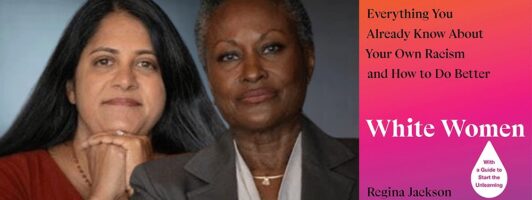
Everything You Already Know About Your Own Racism and How to Do Better.
I recently posted a little life update on my socials where I recommended reading White Women by Regina Jackson and Saira Rao to my very small audience, which is predominantly white women. I also admitted that the book had been hurting my feelings. It really has. Not because I think the book is wrong, but because it has made me look much more honestly at myself than I expected to. I went into White Women thinking I would learn something. I did (much like I had when I read White Fragility). What I didn’t necessarily expect was to spend so much of the book thinking, Oh. I’ve done that, witnessed that, or the worst, I DO that, and that is a very uncomfortable place to be.
I grew up as a white girl in 90’s New Jersey. I’m first-generation American on my father’s side, with an Italian father and a Polish American mother, and I’ve been privileged by my upper-middle-class whiteness for my entire life. I’ve had a lot of what I might once have called “lucky breaks” in my career, especially. My father, an immigrant, instilled an incredible work ethic in me, and my mother always embodied a feminist outlook, even if she never necessarily called it that. My parents are intelligent, hardworking people who didn’t go to college, but they worked, saved, and made sure I had opportunities beyond the public schools I attended. I’m incredibly grateful for the life they gave me.
One of the most formative parts of my childhood was growing up in my father’s pool hall. I was exposed to people from different backgrounds, ethnicities, and socioeconomic circumstances that I might have never met in other situations, and definitely not when I was still in grade school. It taught me early that other people experience the world in a very different way from my own, and that’s perfectly fine, and I had hoped it would be fair.
Knowing that other people’s experiences are different from mine doesn’t automatically make me a good ally. I was a bully from middle school into high school, and I thought I had come to terms with it; now that I’m almost 40 and try to be inclusive and kind. But that’s one of the things White Women has forced me to confront again. The stories told in the book took me back to those times and those people I tended to bully more, and I realized some of them were people of color. I remember going along with my white peers and taunting other kids, partly because I wanted to impress another girl in my grade. I still think about that sometimes and feel ashamed of the person I was, and that’s part of why this book hit me as hard as it did. It wasn’t simply introducing me to behaviors I had never heard of. It was making me think about the gap between the person I believe myself to be and the ways I have actually behaved.
The Problem With Being “Nice”
One of the ideas White Women returns to again and again is the concept of white women’s “niceness”, the expectation that we should be agreeable, positive, pleasant, non-confrontational, and generally make everyone else comfortable. That really got me sour because it’s so true. The book describes how this conditioning contributes to silence and complacency, particularly when confronting racism would require us to stop being comfortable or stop being liked.
One passage that stayed with me was: “No matter what, you are conditioned to remain positive because you’re not supposed to inconvenience the people around you with negative realities. You’re not supposed to seem bitter or shrill. You are conditioned to stay upbeat, to think about the good, to focus on being happy. Doing so requires you to deny, deflect, ease the oppression that is eating away at marginalized populations.” — White Women, p. 125
I had to sit with that one. How often have I confused being nice with being good? How often have I avoided calling it out because I didn’t want to make someone (myself or even the instigator) uncomfortable? How often have I prioritized harmony over honesty? And how often have I thought that because I personally love, respect, and defer to people of different races, I am therefore doing enough? White Women doesn’t let that last question stand.
Recognizing Oppression When It’s Happening to Us
One of the most effective things the book does is draw comparisons between the sexism white women experience, particularly from white men, and the racism white women can perpetuate against Black, Indigenous, and other people of color. The comparison made me stop. White women know what it feels like to be dismissed, talked over, stereotyped, underestimated, or subjected to microaggressions. We know what it’s like to have our experiences minimized or to be told we’re overreacting, but recognizing those behaviors when they’re directed at us doesn’t necessarily mean we recognize them when we’re participating in them.
White Women asks us to sit in that discomfort rather than immediately reaching for the “but I’m not racist” defense. Because identifying as a good person isn’t the same as examining how you participate in systems that benefit you. That’s probably the biggest thing I took away from this book. I think, or at least I thought, of myself as an ally, but when I’m honest with myself, I haven’t always acted like one. I’ve stayed silent. I’ve stayed nice. I’ve stayed comfortable. I’ve stayed complacent, and sometimes I’ve mistaken feeling like an ally for actually doing the work of being one.
A Book You Can’t Just Read and Put Away
One of my favorite practical parts of White Women is the glossary and the discussion and self-accountability questions for each of the chapters. I loved finding these at the end, because they make the book feel like something you’re supposed to do something with, rather than something you’re supposed to finish and congratulate yourself for having read. There are concepts in this book that can feel enormous and difficult to talk about, especially when you’re worried about saying the wrong thing. The glossary gives language to some of those ideas, while the questions give you somewhere to start examining yourself.
And, honestly, I need that. Because I think one of the easiest things to do with a book like this is read it, feel enlightened for a few days, donate some money, share a quote on Instagram, and then go back to your regular life. I’ve done versions of that. I’ve thought I was being an ally when I was really performing allyship. I’ve thrown money at organizations and told myself I was helping. Donating money can absolutely be meaningful and useful, but I no longer think it’s the end of my responsibility.
At some point, I have to look at my own behavior. So, Did I Like It? Yes. But I didn’t always enjoy it, and I think that’s an important distinction.
White Women hurt my feelings because it challenged a version of myself that I had become very comfortable believing in. I wanted to think of myself as a good person, a feminist, an ally, someone who cares deeply about equality. But caring isn’t the finish line. The book reminded me that I can have good intentions and still cause harm. I can love people and still have biases. I can believe in equality and still benefit from systems that aren’t equitable.
None of that makes me uniquely terrible, but it does make me responsible for continuing to learn, and that’s where I think White Women succeeds for me. It doesn’t allow me to make the conversation entirely theoretical. It keeps bringing me back to the question: What am I actually doing?
I don’t want to be a “nice” white woman if being nice means staying silent. I want to be willing to be uncomfortable. I want to listen without becoming defensive. I want to notice when I’m centering myself. I want to recognize when I’m looking for credit for doing the bare minimum. And I want to keep examining the ways I participate in systems I’ve benefited from, even when I don’t like what I find.
I also don’t want to make this review into a story about how much this book made me feel. That would kind of defeat the point, wouldn’t it? My discomfort isn’t the important part. What I do with it is.
So, if you’re a white woman who considers herself an ally, particularly if you’re someone like me who thinks, I already know all of this, I’d actually recommend picking up White Women, because maybe we don’t already know all of this, or maybe we know it intellectually but haven’t really examined how it shows up in our own lives.
For me, that has been the most valuable, and most uncomfortable, part of reading this book. I cannot be free if not all of us are free. Maybe becoming a better ally, or better yet, a true partner in the work, starts with being willing to admit that I haven’t always been one, and then doing better.
Link to Goodreads: White Women: Everything You Already Know About Your Own Racism and How to Do Better by Regina Jackson
My rating: 4 of 5 stars
View all my reviews